

You don’t need to cure it to have a fantastic life.
In 2016, I suddenly developed a very loud case of tinnitus (a constant ringing in the ears) that remains with me today. For the first year or so that I had it, I really didn’t think I was going to survive. Every day was a struggle to just not lose my mind. By the end of the second year, however, I was living a better life than I had before the ringing and I continue to do so today. That had everything to do with shifting my focus.
Onset and early treatment attempts
In late 2016, I was stressed out. I was dealing with pretty complex marital issues and was contemplating divorce. I wasn’t very happy with where I was in life generally speaking. One morning, following a particularly bad argument that ended with me going to bed angry, I woke up, and I had a ringing in my ears as if I had been to a Metallica show with no earplugs – but louder – and it did not get better.
So I did the worst thing you can do when you’re anxious about a physical symptom. I googled it…and wow, what I found tapped into some of my worst fears. Authoritative medical sites like WebMD and Johns Hopkins told me there was no real cure. I found articles about well known celebrities, like William Shatner who had struggled with tinnitus for years. One article I found was about a young guy in Belgium who committed suicide and left behind a note saying he couldn’t stand the noise anymore.
Then I discovered the TinnitusTalk support forum, which has thousands of members, ranging from the newly afflicted with desperate stories to experienced “veterans” who have somehow grown accustomed to the noise. There are also a lucky few who have found something – or a combination of things – that has resulted in significant improvement or even silence again.
The forum is very comprehensive, and I spent a lot of time on it. I learned that a course of prednisone for two weeks was standard treatment at onset, so I went to an ENT, had a full exam, and did the treatment. It didn’t work. The ENT then told me what I already knew: there was no definitive cure, and I may just have to get used to it…and maybe one day it would just go away on its own. The forum consensus is if it doesn’t resolve in two years, it’s permanent.
During the first couple of months, I was getting an hour of sleep every 2-3 days. The noise was just too much for sleep. I spent many early mornings alone, and feeling doubly alone because I was the only one who could hear what I was hearing. The idea that I may never hear silence again was terrifying. I proceeded to try everything within reach – supplements that a friend swore made his tinnitus stop, Chinese herbs, acupuncture – and none of it worked. I even considered returning to the US for long term cognitive-behavioral therapy at a tinnitus clinic that had fairly solid results for many clients.
Applying Sarno and drowning out the noise
If you read my story about overcoming crippling pain, you know that this wasn’t the first time I had struggled with some chronic issue. Years before, I developed a condition that left me unable to even walk across a room with crippling pain. After seeing dozens of doctors and specialists who all had different explanations about what was going on, with some even recommending surgery, I came across Dr. John Sarno’s The Mindbody Prescription. The book’s premise is that many with chronic pain actually have nothing physically wrong, and that the pain, while definitely real, is caused by subconscious rage and kept alive by fear of the pain. His solution involves daily journaling to discover possible sources of this subconscious rage, losing the fear of the pain, and the resumption of physical activity as normal. I found this all really interesting, but I couldn’t take it seriously enough to actually do it until a year later when a crisis made me reconsider. Once I started really doing those things, I went from “unable to walk across a room without crippling pain” to “no pain at all” in about three weeks. This was accomplished without recommended surgery, and without any drugs.
I thought about how I might apply the same solution to my tinnitus. I even did a 30 day treatment program workbook I bought from a close associate of Dr. Sarno’s, Dr. David Schecter’s The Mindbody Workbook. But I felt like losing my fear of the noise in my head would require me to have a fortitude that I just didn’t think I had. When it comes to mind these days, I think of a photo I saw recently of a cyclist in Ukraine going about his routine as if there weren’t tanks on every corner.
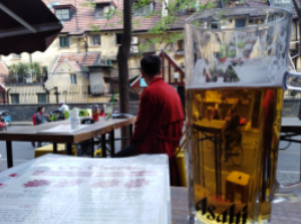
I noticed that when I drank, the volume in my ears lowered considerably. For the first year or so, that became my emergency wonder drug when I couldn’t stand it any longer. I took this picture sometime during that year, and cyclist in the beer mug is a great metaphor for what a large part of that year was for me.
During that time, my tinnitus started following a pattern that made it even harder to cope with: every few days, it would disappear for a day or two, then come roaring back for few days, then lessen in intensity, and disappear again. Every day became either a “good day” or a “bad day”.
Discovering positive psychology and training to shift focus
I discovered another book that year too – Martin Seligman’s Learned Optimism. For those of you who may not know, Martin Seligman basically started a new branch of psychology called positive psychology, which has since become a star player in that field. I was hooked by the second page of the first chapter. I found his ideas to be scary (because he makes it clear that pessimism is a key determiner in quality and duration of life in ways I had never considered), but his ideas were also energizing (because he shows that change is very possible and he gives the tools for it). At around the same time, I got myself a coach who was also a licensed clinical social worker specializing in chronic pain and who was very familiar with Sarno’s work because she had overcome her own pain. She introduced me to the idea of “outcome independence”, which is the ide that you are not emotionally attached to any specific outcome. Somehow I needed to get to a point where I just didn’t give a shit whether the tinnitus stayed or left. I couldn’t imagine ever achieving that…how would I even start to get there? Between the questions she was asking me as my coach and all the reading I was doing, including revisiting Sarno, I decided on a course of action that was small, but it turned out to be the key.
I started going on walks every day. Living in a far flung suburb of Shanghai at the time, it wasn’t hard to find quiet places that at least loosely resembled the quiet forests I so loved to spend time in as a kid in Louisiana. The goal on these walks was to simply shift my attention from the noise in my ears to other sounds in the environment, such as birds chirping, or the wind rustling leaves in the trees. At first I could only manage to do it for a few minutes, but I soon discovered that by doing it, I had five or ten minute periods where I did not hear the tinnitus at all. So I kept doing it, day after day. I’d like to say it all got easier from there, but it didn’t. I still cared. I still had awful days, and I still wound up drinking it away on those days. But I kept at it.
My coach also began encouraging me to start making gratitude lists around this time, even if they just consisted of basic needs being met, like “I have a warm bed to sleep in”. I was skeptical, but I figured if I was going to give it a shot, I might as well be organized about it because I love making charts! This is what I made and used.

My coach was right. It didn’t happen right away, but over time, what I looked at changed. Every evening, I had to sit and review my day and find things I could be grateful for. Over time, I began actively noticing things throughout the day and thinking “Cool! Another thing for my list tonight.” It became habit. I was becoming more optimistic in my outlook…but I still had a ways to go.
A crisis leads to real success
During that year, I decided I needed a career change, and coaching was a perfect fit for me, in spite of – or maybe because of – my struggles, both past and present. In my first year of coaching classes, students were required to read and discuss this book, which outlined a theory of how people change in a series of stages:
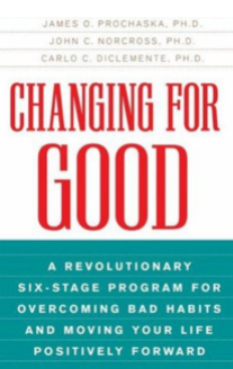
These stages apply to any change someone makes, and the authors make very clear that the final stage of change, maintenance, isn’t necessarily permanent. Regression to earlier stages happens, and may even be beneficial at times. They also emphasize that these stages aren’t linear – we often move back and forth between them before successfully implementing change.
And this is exactly what I experienced during Chinese New Year in 2018, when I had a crisis of confidence in my progress coupled with an overwhelming sense of loneliness. Relationship issues had come to a head, and I had been trying to resolve a serious tax issue with the IRS. For about a week, I was caught up in the darkest depression I had ever experienced. Up to that point in my life, I had always been an introvert at heart, with a small circle of friends and acquaintances. I was uncomfortable around new people, and I didn’t get out of my work bubble much. I decided that had to change.
I had always loved playing badminton, and I hadn’t played for a long time, so that’s where I started – I found a group on Meetup and joined. I was anxious about it because my tinnitus always seemed to get louder as the environment I was in got louder – and that made teaching middle schoolers so much tougher for me. I forced myself to start talking to people every time I went to play, and every time I went I had to accept that the noise in my ears would get louder. But my world started opening up. I got invited to other events, and made myself meet new people each time. It started to become not only easier, but something I looked forward to. Very quickly, I realized that shifting my focus didn’t have to be limited to my walks, and it didn’t have to be work. All I needed was to be engaged – really into – whatever I was doing. The proof for me was the fact that I was beginning to go hours at a time without noticing the noise. The more that happened, the less I worried about the noise. The less I worried, the less I cared what it was doing. I had other shit to do! I was getting much closer to outcome independence without even realizing it. By early 2019, I didn’t feel a need to meet with my coach any longer.
Focus tested and passed!
Lockdown in Shanghai in April-May 2022 was tough. This is what I looked like every time I had to go out for testing, because it was clear within the first couple of weeks that the testing lines people were forced to stand in at least once a day were where most of the tens of thousands of new infections were occurring.
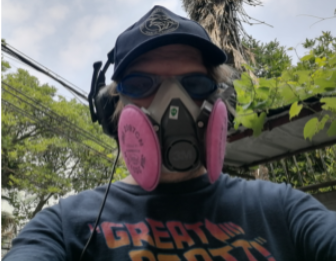
Looking back, I don’t remember tinnitus being an issue at all during those couple of months, but by all rights, it should have been. It tends to be much easier to notice when I’m really stressed. I think it wasn’t noticeable during lockdown because I was so focused on and concerned about basic survival stuff (such as finding food) and contingency planning (how am I going to handle things like serious medical issues that require getting to a hospital?).
Since early 2018, I’d say I’ve been living a better life than I had before tinnitus came around. Much of the time, I don’t notice the noise at all, and the only time it comes to my attention is when it comes up in conversation (which is rare these days) and in the course of writing about the experience. I had my reservations about writing this because of that, but the fact that I went ahead and did it anyway is a measure of how far I’ve come. Is the noise a significant annoyance at times? Sure, in the same way bad traffic can be. But just like most of us don’t fear traffic, I no longer fear the noise. It’s here now, but there’s no need to give it attention or worry about it. I’ve been getting along with my life for years just fine whether it’s there or not, and as soon as I’m engaged doing anything that’s not related to that noise, it will disappear. It’s not a cure, but learning how to shift my focus is a solution I’m pretty happy with, and it’s a great skill to develop, because it can be applied to just about any situation.
My struggles with chronic pain and tinnitus were often lonely experiences in that empathy and practical solutions were scarce from those closest to me, as well as from some healthcare professionals. As someone who understands not just the surface problems but the deep-seated battles that come with these issues and others, I now offer the support I once desperately needed. Your battles can be won, and sustainable change is possible. While I won’t guarantee success because that depends primarily on the work that you do in and beyond coaching sessions, you can expect that for the duration of our working relationship, I will be personally committed to helping you achieve sustainable goals that are important to you. Get in touch for a free consultation to discuss how we can work together!